Did Lewis Carroll Really Invent The Word Ladder?
He is the person the puzzle is credited to, and the earliest published version is his. Charles Lutwidge Dodgson, who wrote as Lewis Carroll, described how the game began in a letter printed in Vanity Fair in March 1879. Two young ladies, he wrote, had asked him for riddles one Christmas, ‘a year ago last Christmas’, which places it at Christmas 1877. Having none to hand, he came up with a new game instead. He called it new ‘at least to me’, a modest way of saying he did not know of anyone who had done it before.
His first name for it was Word-Links, and a printed rules sheet under that title survives from 1878. By the time it reached Vanity Fair, it had become Doublets.
What Are Doublets?
Doublets is Carroll’s name for the word ladder. His rules, set out in the 1879 book, will feel familiar to anyone who has solved one today:
- Two words of the same length are given. Together they are called a Doublet.
- The solver puts other words between them, called Links, each differing from the one before by a single letter.
- The whole series, from the first word to the last, is called a Chain.
- The aim is to complete the Chain with as few Links as possible.
So a modern rung is Carroll’s Link, and a modern ladder is his Chain.
When Did Doublets First Appear?
| Date | What Happened |
|---|---|
| Christmas 1877 | Carroll devises the game for two young friends, by his own account. |
| 1878 | A printed rules sheet, titled Word-Links, is produced. |
| 29 March 1879 | Vanity Fair publishes the puzzle as Doublets, with Carroll’s letter about its origin. |
| 1879 | Macmillan publishes Doublets: A Word-Puzzle as a small book. |
| 1879 To 1880 | Vanity Fair runs regular Doublets with a scoring competition, and Carroll revises the rules and scoring. |
| 1880 | An expanded edition of the book appears, with more Doublets. |
What Were Carroll’s Own Examples?
The 1879 book shows how HEAD can be changed into TAIL by putting in four Links:
HEAD, HEAL, TEAL, TELL, TALL, TAIL
It also lists the Doublets already set in Vanity Fair, each with a playful instruction, and gives Carroll’s answers. Here are five of them:
| Carroll’s Instruction | His Chain |
|---|---|
| Drive PIG Into STY | PIG, PIT, SIT, SAT, SAY, STY |
| Raise FOUR To FIVE | FOUR, FOUL, FOOL, FOOT, FORT, FORE, FIRE, FIVE |
| Make WHEAT Into BREAD | WHEAT, CHEAT, CHEAP, CHEEP, CREEP, CREED, BREED, BREAD |
| Evolve MAN From APE | APE, ARE, ERE, ERR, EAR, MAR, MAN |
| Change TEARS Into SMILE | TEARS, SEARS, STARS, STARE, STALE, STILE, SMILE |
Notice how the instructions tell a tiny story: a pig driven into its sty, wheat made into bread, tears turned into a smile. Carroll chose pairs of words that belong together, which is a large part of the charm.
Why Is It Called A Word Ladder?
The puzzle has had many names. Besides Doublets and Word-Links, it has been called change-the-word, paragrams, laddergrams and word golf. Today it is most often called a word ladder, a name that suits the way the chain is usually written: a column of words, each one a rung, climbing from the start word to the finish word.
Who Else Played Word Golf?
The puzzle turns up in some unexpected places. In Vladimir Nabokov’s 1962 novel Pale Fire, the narrator, Charles Kinbote, says the poet John Shade had a weakness for word games, ‘especially for so-called word golf’, and records his own best scores, such as turning HATE into LOVE in three moves and LIVE into DEAD in five. In golf terms, the fewer the strokes the better, which is exactly Carroll’s rule of using as few Links as possible.
Word ladders also caught the eye of computer scientists. In The Stanford GraphBase, published in 1994, Donald Knuth included a list of 5,757 five-letter English words. Treating each word as a point and joining any two words that differ by one letter turns the list into a network, so finding a word ladder becomes a question of finding a path from one point to another.
How Do Doublets Compare With Word Ladders Today?
The rule at the heart of the puzzle has not changed since 1879: one letter at a time, real words only. What has changed is how puzzles are presented. Carroll asked solvers to find the shortest chain they could. Most modern word ladders fix the number of steps for you, and many add a clue for each missing word, so the puzzle is about finding the intended route rather than any route.
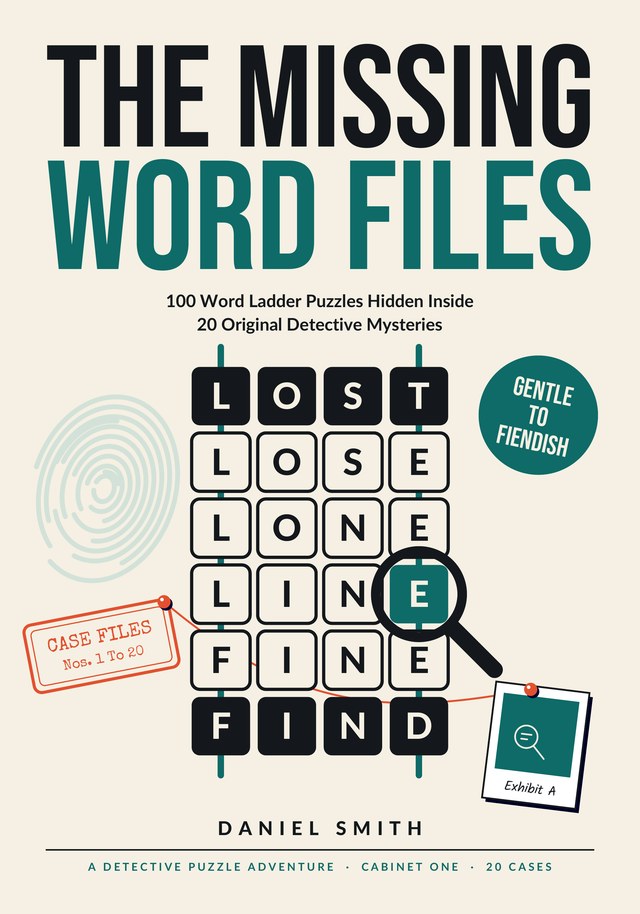
The Missing Word Files takes that one step further, turning the ladder into a mystery puzzle book. Each ladder is a piece of evidence in a cosy detective case: one square in each ladder is shaded, and the five shaded letters spell the word that solves the mystery. If you would like to try the modern form first, our guide to solving word ladders walks through the method, and our word ladder examples with answers give you fifteen to practise on.
Sources
- Lewis Carroll, Doublets: A Word-Puzzle (Macmillan, 1879), including his letter to Vanity Fair dated 29 March 1879 and the list of Doublets already set. Transcribed text: The (Almost Really) Complete Works Of Lewis Carroll.
- Word-Links printed rules sheet, 1878: The (Almost Really) Complete Works Of Lewis Carroll.
- Doublets, Lewis Carroll Resources: Word-Links devised around Christmas 1877, and the later Vanity Fair puzzles.
- Open Library record of the 1880 Macmillan edition of Doublets.
- Word ladder, Wikipedia, citing Tony Augarde, The Oxford Guide to Word Games, for the puzzle’s other names.
- Vladimir Nabokov, Pale Fire (1962), commentary to line 819.
- Donald Knuth, The Stanford GraphBase (ACM Press and Addison-Wesley, 1994).